The Jobs AI Helps Most Are the Ones It's Most Likely to Replace
Written by Derek Chua, digital marketing consultant and founder of Magnified Technologies. Derek runs AI agents in production daily across client and internal business workflows.
A new study from Tufts University just released something worth sitting with.
Their American AI Jobs Risk Index ranked 784 occupations by how likely they are to lose jobs because of AI. The uncomfortable finding: the jobs most helped by AI tools are also the jobs most likely to be cut.
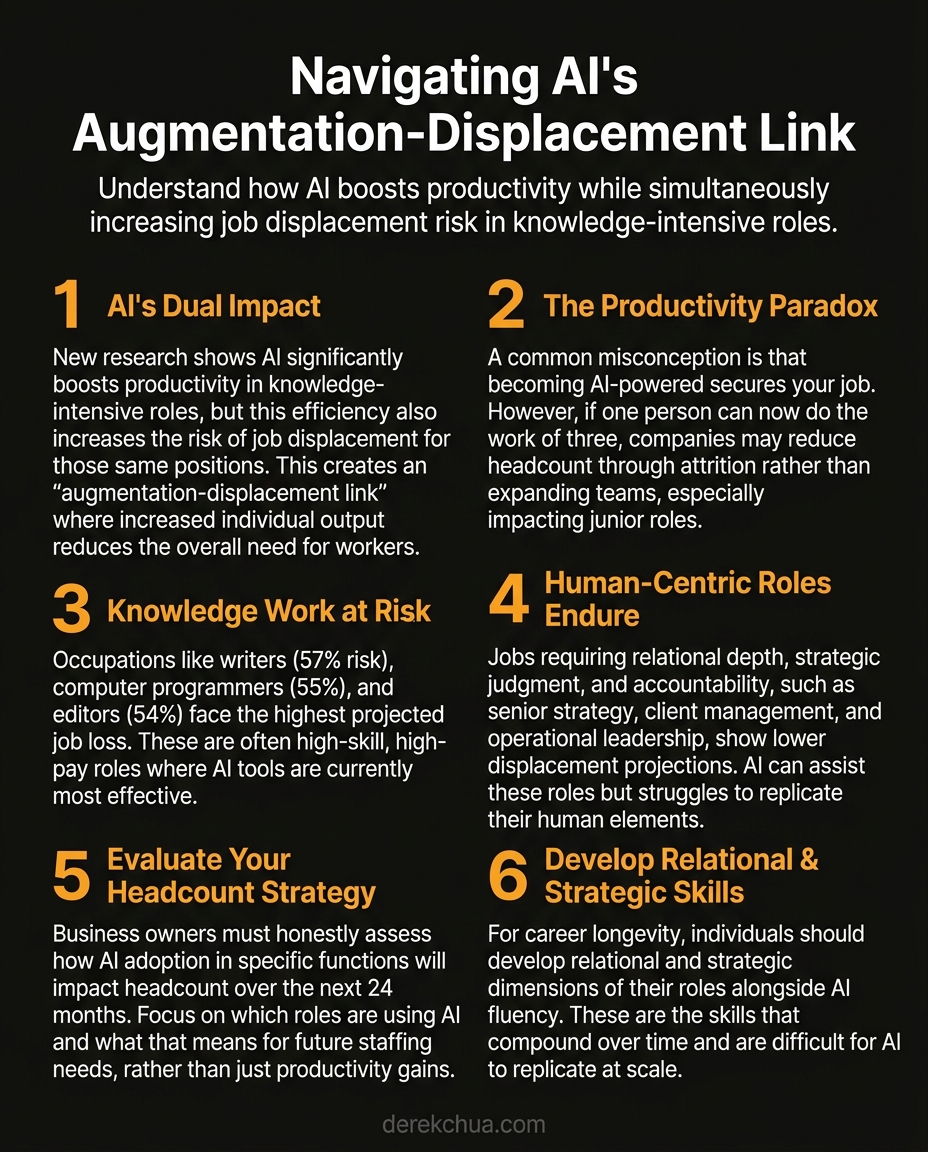
Key Takeaway: AI is creating what researchers call the "augmentation-displacement link." When AI makes individual workers significantly more productive, companies need fewer of those workers to produce the same output. If you are in a knowledge-intensive role, both the opportunity and the risk are real, and they are connected.
Writers and authors top the list at 57% projected job loss risk. Computer programmers at 55%. Web and digital interface designers at 55%. Editors at 54%. Market research analysts at 35%. PR specialists at 37%.
These are not low-skill jobs. These are exactly the professions where AI tools feel most useful right now.
Why Getting Better at Using AI Does Not Automatically Protect You
This is the part most people miss.
There is a widespread assumption that becoming an "AI-powered" version of your role will secure your position. Learn Claude. Learn Cursor. Get 10x more productive. Job saved.
The Tufts research suggests the opposite may be true for certain roles. When one person can now do the work of three, companies do not necessarily hire three times as many people. They hire fewer.
The researchers call it the augmentation-displacement link. AI increases your individual output, but it also decreases the number of people a company needs to fill that function.
This hits entry-level and junior roles first, because companies can slow hiring rather than fire existing staff. A team of five writers becomes a team of two, not through layoffs, but through attrition. Quietly. Over two years.
For SME owners, this has specific implications. You may be actively building your team's AI skills, celebrating the productivity gains, without seeing what is happening to your hiring pipeline and headcount over the medium term.
The Numbers Behind the Headline
The index covers 784 U.S. occupations, 530 metro areas, 50 states, and 20 industry sectors. The median scenario estimates 9.3 million jobs at risk from AI, ranging from 2.7 million to 19.5 million depending on how fast AI adoption moves.
By industry, the highest projected job loss rates sit in Information (18%), Finance and Insurance (16%), and Professional, Scientific, and Technical Services (16%).
Software developers, management analysts, and market research analysts account for a disproportionate share of the $757 billion in total at-risk annual income. High pay, large workforce, and tasks that AI handles increasingly well.
The study also notes that job creation data is not yet included. The authors plan to add that in future updates. So this is not the full picture. But the displacement side is the part most businesses have not properly accounted for yet.
What Business Owners Should Pay Attention To
At Magnified, we have watched this pattern play out across marketing and professional services clients over the past two years. Businesses that adopted AI content tools in 2024 are running with smaller content teams heading into 2026. Not because leadership made a deliberate decision to cut headcount. Because the work requires fewer hands. Output quality stayed the same or improved. The team quietly got smaller through attrition and reduced hiring.
The question for any business leader is straightforward: which roles in your business are you applying AI to, and what is your honest expectation about headcount in those functions 24 months from now?
That is not a comfortable question. But it is a more useful one than "how do we use AI to be more productive," which most businesses are already asking.
The Roles That Hold Up Better
Not everything on the list is high risk. Jobs that combine AI fluency with relational depth, judgment, and accountability are holding up better.
Senior strategy, client management, sales, and operational leadership have lower displacement projections. These roles involve trust built over time, context that accumulates through relationships, and judgment calls that carry real consequences for real people. AI can assist these roles significantly. Replicating them is harder.
The distinction is not manual versus knowledge work. It is tasks that are primarily structured and cognitive versus tasks that require human judgment and relationships. Writing a blog post is a structured cognitive task. Advising a business owner through a difficult decision is not. Analysing a dataset is increasingly automated. Interpreting what that data means for your specific business, with your specific history and constraints, still requires a human.
For employees thinking about career development: the goal is not to avoid AI tools. It is to develop the relational and strategic dimensions of your role alongside your AI fluency. Those are the dimensions that compound over time and that AI cannot replicate at scale.
Derek's Take
The Tufts findings match what I have been observing on the ground.
The productivity gains are real. So is the compression of headcount in knowledge work functions.
What the research does not yet capture is the job creation side: the new roles emerging around AI implementation, workflow design, oversight, and quality control that did not exist two years ago. Those roles are real. The question is whether they will offset what is disappearing, and whether the people being displaced are positioned to fill them.
My honest read: the people who will navigate this well are not those who use AI the most. They are those who understand where to apply it, when to hold back, and how to keep developing the relational and strategic dimensions of their work that AI cannot touch.
That is a harder skill to develop than learning a new tool. But it is the one that actually matters over a five-year horizon.
One Action for This Week
Map out the functions in your business where AI tools are actively being used to boost productivity. For each one, ask: if output stays the same but individual efficiency doubles, what happens to headcount in that function over the next 24 months?
Do that exercise now, before circumstances do it for you.
Frequently Asked Questions
What is the American AI Jobs Risk Index? The American AI Jobs Risk Index is research from Digital Planet at Tufts University's Fletcher School. It ranks 784 U.S. occupations, 530 metro areas, and 20 industry sectors by projected vulnerability to AI-driven job displacement. The median scenario estimates 9.3 million jobs at risk, with the range spanning 2.7 million to 19.5 million depending on the pace of AI adoption. All figures are model projections, not confirmed layoff data.
Which occupations face the highest AI displacement risk? Writers and authors top the list at 57% projected job loss risk, followed by computer programmers and web and digital interface designers at 55% each, editors at 54%, and public relations specialists and market research analysts in the 35 to 37% range. These are knowledge-intensive, language-heavy, and cognitively structured roles where AI tools are already delivering significant productivity gains.
Does this affect businesses and employees outside the U.S.? The index is U.S.-focused, but the underlying dynamic, AI-driven productivity gains leading to reduced headcount in knowledge work, is not specific to any market. Professional services, marketing, content, and software development roles globally face the same structural pressures. Pace of impact will vary by local labour regulation, AI adoption rates, and industry.
Should employees stop building AI skills to protect their jobs? No. The risk is not from being skilled with AI. The risk comes from being in a role where the primary value you add is structured, replicable, and cognitive at scale. The practical answer is to develop your relational, judgment-based, and strategic capabilities alongside your AI fluency. People who combine strong domain expertise and judgment with AI skills are in the best position, not those who avoid tools, and not those who only know how to use tools.
Magnified Technologies works with SME leadership teams on AI adoption strategy, from deciding what to automate to understanding the workforce implications. Get in touch here.