Your Team Is Already Splitting in Two on AI. Here's What to Do About It.
Written by Derek Chua, digital marketing consultant and founder of Magnified Technologies. Derek has run multi-agent AI marketing systems in production for over a year and works with SMEs navigating real-world AI adoption.
A few months back, I asked a marketing team I work with a simple question: "Who here used AI for their work this week?" The room split almost exactly down the middle. Half raised their hands. The other half looked at each other.
Nobody had told either group what to do. They had just... diverged.
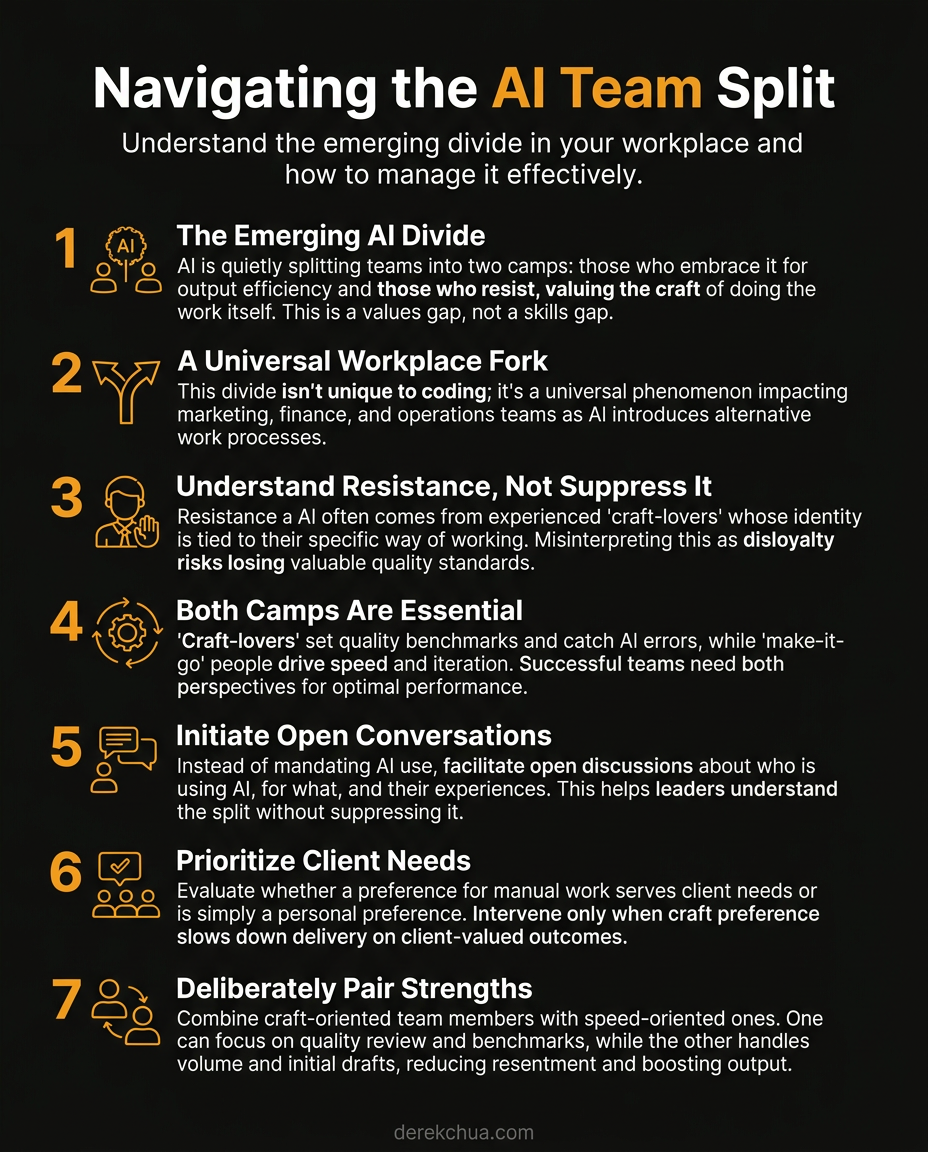
Key Takeaway: AI is quietly splitting teams into two camps: those who use it to direct output, and those who resist because they valued the craft of doing the work itself. This split is not a loyalty problem or a skills gap. It is a values gap, and how you handle it will shape your team culture for years.
The Study That Put This Into Words
Last week, the New York Times Magazine published a major feature called "Coding After Coders," written by journalist Clive Thompson. He interviewed more than 70 software developers from Google, Amazon, Microsoft, and Apple about how AI has changed their work.
The article is ostensibly about programming. But buried inside it is one of the most honest descriptions I have read of what AI is doing to professional teams everywhere.
Developer and writer Les Orchard captured the core dynamic better than anyone. His framing:
"Before AI, both camps were doing the same thing every day. Writing code by hand. Using the same editors, the same languages, the same pull request workflows. The craft-lovers and the make-it-go people sat next to each other, shipped the same products, looked indistinguishable. The motivation behind the work was invisible because the process was identical.
Now there's a fork in the road. You can let the machine write the code and focus on directing what gets built, or you can insist on hand-crafting it. And suddenly the reason you got into this in the first place becomes visible."
The fork. That is what is happening in your business right now, whether you have noticed it or not.
This Is Not a Coding Story
Reading the NYT piece through the lens of an SME owner, what struck me was not the programming detail. It was how universally applicable the split is.
Marketing teams: the person who loved writing copy because they loved finding the perfect word vs. the person who wants the campaign live by Tuesday. Finance teams: the analyst who built elaborate Excel models because they genuinely enjoyed the construction vs. the one who just needs the numbers. Operations: the ops manager who memorised every workflow detail by heart vs. the one who wants the process automated so they can move on.
Every team has both kinds of people. Before AI, they were doing the same tasks, at roughly the same pace. The work looked the same from the outside.
Now the fork is visible. And if you have not yet felt the tension in your team, you will.
One of the developers in the NYT piece, an Apple engineer, said he found AI coding "strips you of the fun." He asked to remain anonymous, the article noted, "so he wouldn't get in trouble for criticizing Apple's embrace of AI."
That detail is worth sitting with. A professional at one of the most powerful companies on earth felt he could not safely say he preferred doing his work the old way. That is a culture problem. And it is one that small businesses can avoid if they handle this early.
What I Have Seen at Magnified
At Magnified, we have run a multi-agent AI content system for over a year now. Multiple AI agents handle research, first drafts, SEO analysis, and publishing workflows. What started as an experiment is now how we operate.
Here is what I have observed about the people involved: resistance to AI does not correlate with skill level. Some of the most technically capable people on teams I work with are the slowest to adopt, because they built real expertise and real identity around doing the work in a specific way. The work was the point, not just the output.
And some of the least experienced people are the most enthusiastic adopters, because they always cared about results and never had a strong attachment to the process.
Neither orientation is wrong. The craft-lover is often your quality bar. They are the one who notices when the AI output is slightly off, when the tone is generic, when something important is missing. The make-it-go person ships and iterates. You need both.
The problem arises when leaders misread the craft-lover's hesitation as disloyalty or incompetence, and push them out or over. You are more likely to lose your quality standards than you are to gain speed.
Three Things Worth Doing This Week
1. Have the conversation openly, not as a mandate.
Do not call a meeting where AI adoption is framed as a performance requirement. Call a meeting where the question is: "Who is using AI, for what, and what do you think of it?" Let the split surface. The goal is to understand it, not suppress it.
2. Separate "I like doing this" from "this is what our clients need."
Both matter. If someone on your team loves crafting something by hand and the result serves your clients well, that is not a problem to solve. If the craft preference is slowing down delivery on things clients care about, that is a real conversation to have. Know the difference before you intervene.
3. Pair the two camps deliberately.
The teams I have seen do this well pair a craft-oriented person with a speed-oriented person on the same output. One sets the quality benchmark and reviews the final product. The other handles volume and drafts. The combination outperforms either working alone. It also tends to reduce resentment on both sides, because each person is contributing what they actually value.
The Honest Take
There is a line in the NYT piece where Simon Willison, a prominent developer, is quoted saying: "If you're a lawyer, you're screwed, right? There's no way to automatically check a legal brief written by AI for hallucinations."
His point was that programmers have it relatively easy because they can test whether the code works. Most professionals do not have that automatic verification mechanism.
Which means for the majority of jobs, AI adoption requires more human judgment, not less. The craft-lovers on your team may be the ones who instinctively understand that. Their resistance is sometimes not fear of the new tool; it is a recognition that the tool needs a human with deep expertise to catch what it gets wrong.
That is a different problem to solve than pure resistance. And it is worth understanding which one you are actually dealing with.
Frequently Asked Questions
What is the "AI split" in the workplace? The AI split refers to a divide that is emerging in teams between employees who embrace AI to direct and accelerate their output, and those who resist because they value the craft of doing the work itself. The split was always latent in teams but has become visible now that AI offers a genuine alternative process. It is not simply about technical skill or openness to change.
Should I require my team to use AI tools? Mandating AI usage without context tends to backfire. It suppresses honest feedback, drives resistance underground, and risks losing employees who do valuable quality work. A better approach is to create space for genuine conversation about how the team is already using AI, what is working, and where it is not. Adoption that emerges from that conversation tends to be more durable than top-down mandates.
How do I handle employees who resist AI adoption? Start by understanding the reason for the resistance. Is it a craft identity issue (they valued the process itself)? A quality concern (they do not trust the output)? Or a workflow problem (the tool does not fit how they actually work)? Each calls for a different response. Blanket dismissal of resistant employees often removes your best quality gatekeepers.
Does the AI split happen in non-technical roles? Yes. The same dynamic plays out in marketing, finance, operations, customer service, and design. Any role where some people valued the craft of doing the work, not just the outcome, will surface this split when AI offers a faster alternative. The coding world is just the first place it has been studied and documented in depth.
The split on your team is already forming. The question is not whether to address it, but whether you get ahead of it with intention or stumble into it by default.
Most leaders will wait until there is tension to act. The better move is to look at your team now, before it becomes a retention or culture problem, and make some deliberate choices about what kind of work environment you are building.
You still get to shape that. For now.
Derek Chua is a digital marketing consultant and founder of Magnified Technologies, an AI-first digital marketing agency based in Singapore. He writes about practical AI adoption for business leaders.