GPT-5.4 Is Out. The Part That Actually Matters for Your Business.
Written by Derek Chua, digital marketing consultant and founder of Magnified Technologies. He runs multi-agent AI systems in production and writes about what actually works for business owners navigating AI adoption.
OpenAI released GPT-5.4 yesterday. There will be no shortage of posts today covering the benchmarks and capability comparisons. This is not that post.
What I want to focus on is the part that matters for business owners: what GPT-5.4 can do that its predecessors genuinely could not, and whether any of that is worth your attention right now.
Key Takeaway: GPT-5.4 introduces two genuinely new capabilities for professional work: native computer use (AI that operates software like a human would) and knowledge work quality that matches real professionals in 83% of tested tasks. For SMEs with legacy systems or heavy office work, this is the most practically significant model update in months.
What Actually Happened
OpenAI released GPT-5.4 on March 5, 2026. Two versions: GPT-5.4 (available in ChatGPT as "GPT-5.4 Thinking," and in the API) and GPT-5.4 Pro (for maximum performance on complex tasks). It's also available in Codex, OpenAI's coding tool.
The pricing sits slightly above the GPT-5.2 family.
A few things stand out from the announcement:
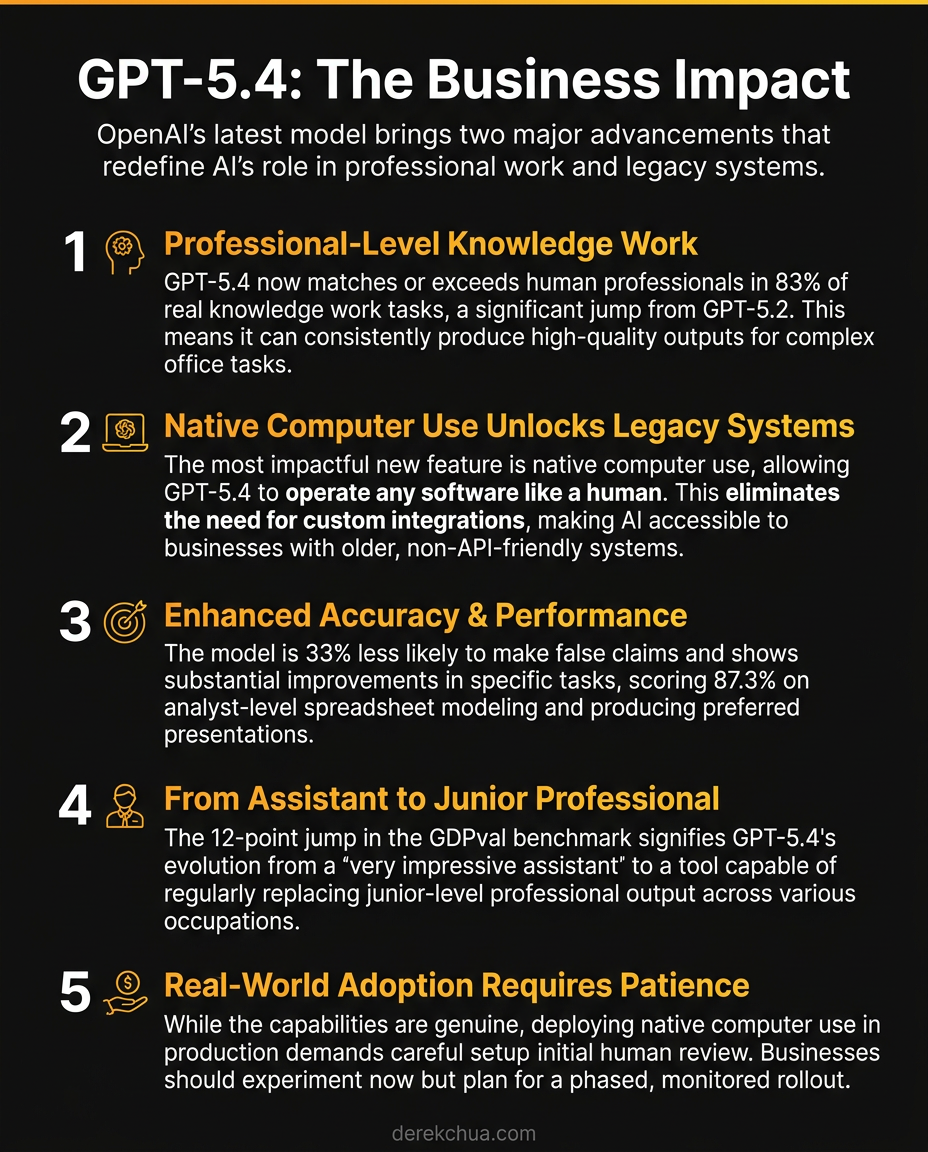
- On GDPval, a benchmark testing AI performance across 44 real professional occupations, GPT-5.4 matches or exceeds professionals 83% of the time. GPT-5.2 sat at 70.9%.
- It is the first general-purpose model OpenAI has released with native computer use built in.
- It is 33% less likely to state a false claim compared to GPT-5.2.
- On spreadsheet modelling tasks equivalent to junior analyst work, GPT-5.4 scores 87.3%, against 68.4% for GPT-5.2.
- It supports up to 1 million tokens of context.
The GDPval number is the headline, but the computer use capability is the more consequential development for businesses.
Why Computer Use Is the Story Nobody Is Leading With
Most AI coverage focuses on benchmark scores and writing quality. Computer use is harder to explain and easier to miss in a changelog, but it is the capability that unblocks a class of AI use cases that simply was not possible before.
Here is the problem: most businesses run on software that was built before AI existed. A purpose-built CRM from 2015. An accounting system the vendor stopped updating. An industry-specific tool that does exactly what it needs to do, and that nobody is ever replacing, but that has zero integration with modern AI tools.
Until recently, getting AI to work inside these systems meant one of two things: pay developers to build a custom connector, or live without it.
GPT-5.4 changes that calculation. Native computer use means the model can look at a screen, read what is there, and interact with it the way a human would. Click a button. Fill in a form. Navigate across multiple tabs and pull information together. No API required.
Anthropic has been working on computer use for a while with Claude, and GPT-5.4 now brings the same capability to OpenAI's ecosystem. On OSWorld-Verified, a benchmark that tests AI performance on real software tasks (Chrome, LibreOffice, VS Code), GPT-5.4 scores 75%. GPT-5.2 was at 47.3%.
For context on what 75% means practically: early users are reporting human-level performance on navigating complex spreadsheets and completing multi-step web forms. The model is not superhuman. But it is no longer a toy.
What Changed for Knowledge Work
The 83% GDPval figure deserves a closer look. This benchmark is not testing clever text generation. It is testing agents completing actual professional tasks across 44 occupations in the top industries by GDP contribution. The outputs are things like sales presentations, accounting spreadsheets, schedules, and manufacturing diagrams.
A human professional judges whether the output is up to standard. GPT-5.4 wins or ties 83% of those comparisons.
For context, GPT-5.2 was at 70.9% on the same benchmark. That 12-point jump represents a model that has moved from "very impressive assistant" to "regularly replacing junior-level professional output."
The office work improvements are specific and measurable:
- Spreadsheet modelling: 87.3% on analyst-level tasks, versus 68.4% for GPT-5.2.
- Presentations: humans preferred GPT-5.4 outputs 68% of the time over GPT-5.2, citing stronger design, visual variety, and image use.
- Factual accuracy: 33% fewer false claims, 18% fewer responses containing any error at all.
OpenAI also launched a ChatGPT for Excel add-in today, aimed at Enterprise customers. If you use Excel heavily for financial modelling or reporting, that is worth watching.
Is This Hype or Real?
In my honest view: the GDPval benchmark is credible and the gap versus the previous generation is meaningful. This is not a marginal improvement dressed up as a major release.
The computer use claim is where I would encourage some patience. The benchmark scores are strong. Production results, based on what I have seen with similar capabilities in Claude, will vary significantly depending on the software you are trying to use and how consistent its interface is. Some tools will work well. Others will need a lot of configuration and error-handling before they are reliable enough to deploy unsupervised.
At Magnified, we started experimenting with computer use for client reporting tasks earlier this year. The capability works. But it requires more careful setup than prompt-based automation, and you need a human reviewing outputs until you have built enough confidence in its reliability on your specific tools.
The headline is real. The timeline from "I want to try this" to "this is running in production" will depend on your setup.
The One Change Worth Your Attention This Week
If you use ChatGPT, switch to GPT-5.4 Thinking for any substantive office work you are doing this week. Give it a real spreadsheet task, a presentation brief, or a financial summary to work through.
The upgrade from GPT-5.2 to 5.4 is meaningful enough that you will notice a difference on tasks that require structure, accuracy, and multi-step reasoning. It is not a subtle incremental improvement.
If you are technically inclined and building tools, GPT-5.4's API is where the computer use capability lives. It is worth understanding even if you are not ready to deploy it, because it will change what is possible when you are.
For businesses with legacy systems that could never plug into AI: this is the development worth watching most closely over the next six to twelve months. The technical groundwork is being laid. Getting AI to operate your existing software is no longer a five-year horizon question.
Frequently Asked Questions
What is GPT-5.4, and how is it different from GPT-5.2? GPT-5.4 is OpenAI's latest frontier model, released on March 5, 2026. The most significant differences from GPT-5.2 are native computer use capabilities (the model can operate software the way a human does), stronger knowledge work performance (83% match rate against professionals on GDPval, up from 70.9%), substantially better spreadsheet and presentation output, and 33% fewer factual errors. It also supports up to 1 million tokens of context. Pricing is slightly higher than GPT-5.2.
What does "computer use" mean, and how does it work? Computer use means the AI model can see a screen and interact with software the same way a human would: clicking buttons, filling forms, navigating menus, and pulling information across multiple windows. It does not require the software to have an API or any AI integration. The model processes visual information from the screen and takes action based on what it sees. This makes it possible to automate tasks in legacy or niche business software that could never connect to AI tools through traditional integrations.
Should my business switch to GPT-5.4 right now? For day-to-day ChatGPT use involving documents, spreadsheets, presentations, or research, yes, switching to GPT-5.4 Thinking is worth doing now. The improvement in output quality and factual accuracy is meaningful. For computer use automation in production workflows, a more careful evaluation makes sense. The capability is real, but deploying it reliably in your specific software environment will require testing and setup before you trust it unsupervised.
Is this better than Claude for business use? GPT-5.4 and Claude Sonnet 4.6 (released in February) are now comparable at the frontier. Both are significantly better than their previous generations. GPT-5.4's strength is tightly integrated computer use and strong structured output for office work. Claude's strengths include coding, long-context reasoning, and agent planning. For most business applications, the differences are less important than choosing one, learning it well, and applying it consistently. Running one agent-class model well beats having accounts on every platform.
What is the ChatGPT for Excel add-in? OpenAI launched a ChatGPT for Excel add-in alongside GPT-5.4, currently for Enterprise customers. It brings GPT-5.4's spreadsheet capabilities directly into Excel, allowing users to build models, generate formulas, analyse data, and create reports from within the spreadsheet interface. If your team relies heavily on Excel for financial modelling or reporting, this is worth requesting access to and evaluating.