Google Just Made High-Volume AI 8x Cheaper. Here's What To Do With That.
Written by Derek Chua, digital marketing consultant and founder of Magnified Technologies. He builds and manages multi-agent AI systems for businesses across Singapore and the region.
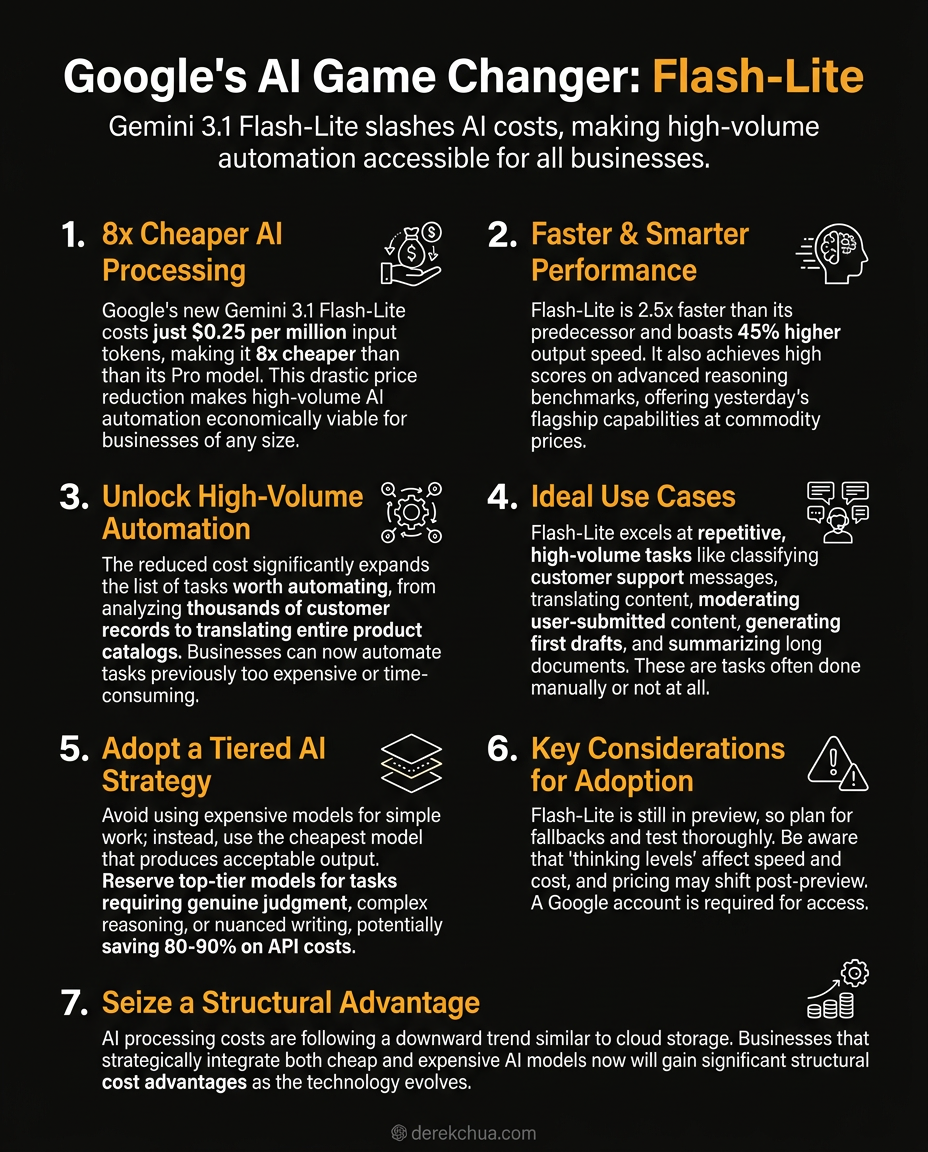
On March 3, Google released Gemini 3.1 Flash-Lite. The price: $0.25 per million input tokens, $1.50 per million output tokens.
For context, that's roughly 8x cheaper than Gemini 3.1 Pro. And it outperforms the previous Flash generation on both speed and reasoning benchmarks.
The AI price war you've been reading about just hit your favour.
Key Takeaway: Google's Gemini 3.1 Flash-Lite makes high-volume AI automation economically viable for businesses of any size. At $0.25 per million tokens, the cost barrier for running AI at scale has effectively disappeared — and the question now is which tasks you should immediately automate.
What Actually Happened
Google's Gemini team shipped Gemini 3.1 Flash-Lite in preview on March 3, 2026. It's available today through Google AI Studio (free for developers) and Vertex AI (enterprise). The specifications worth noting:
- $0.25 per million input tokens, $1.50 per million output tokens
- 2.5x faster than Gemini 2.5 Flash, with 45% higher output speed
- Built-in "thinking levels" — you choose how much the model reasons before answering
- 86.9% on GPQA Diamond (a graduate-level science reasoning benchmark that trips up most models)
That last point deserves a second read. This cheap, fast model scores better on advanced reasoning benchmarks than larger Gemini models from the previous generation. You are not paying for a cut-down version of something else. You're paying commodity prices for yesterday's flagship capability.
Why This Is a Bigger Deal Than It Looks
Every time AI processing costs drop significantly, the list of things worth automating gets longer.
Analysing 50,000 customer records used to cost real money. Today, it might cost a few dollars. Translating your entire product catalogue into three languages used to require a budget line and a timeline. Today, you could run it over lunch.
The economics of AI work have changed, and the businesses that adjust their thinking along with the prices will pull ahead of those still treating AI as a premium, occasional tool.
What Google is doing here fits a broader pattern across the industry. OpenAI, Anthropic, Google, Mistral — all of them are building tiered model pricing. Cheap and fast for volume. Expensive and smart for judgment. The companies learning to use both tiers correctly are building a structural cost advantage that compounds over time.
What Your Business Should Actually Do With This
Find your highest-volume, most repetitive AI task
Flash-Lite is designed for tasks you need to run thousands or millions of times. Think:
- Classifying and tagging incoming customer support messages before routing them
- Translating product listings, SOPs, or marketing copy into multiple languages
- Moderating or scoring user-submitted content at scale
- Generating first drafts of standard documents (quotations, proposals, email responses)
- Summarising long email threads or documents before a human reviews them
These are tasks most businesses are either doing manually or simply not doing at all. At $0.25 per million tokens, the automation case is almost always financially obvious.
Stop using expensive models for simple work
This is the most common mistake I see. A team builds an AI workflow using GPT-4o or Claude Sonnet for everything, because those are the models they know and trust. Then the API bill arrives and the economics fall apart.
The right architecture is simple: use the cheapest model that produces acceptable output. Save expensive models for tasks requiring genuine judgment, nuanced writing, or complex multi-step reasoning. Use Flash-Lite for the volume work underneath.
At Magnified, we run multi-model setups across our client automation systems — cheaper models handle classification, routing, translation, and summaries, while more capable models step in only when the task demands real reasoning. The cost difference is substantial. We regularly see 80 to 90 percent lower API costs for the same output volume, compared to running everything through a top-tier model.
Know what you're getting into before migrating
A few practical watch-outs:
It's still in preview. Flash-Lite is rolling out in preview as of today, not general availability. Do not anchor a production-critical workflow to it without a fallback model configured. Test thoroughly before committing.
Thinking levels affect speed and cost. The built-in "thinking" feature is useful for complex tasks, but at higher settings it adds latency and token usage. For most high-volume use cases — translation, classification, summarisation — minimal thinking is exactly what you want.
You need a Google account. Google AI Studio is free to sign up and experiment. If your team is already in the Google Workspace ecosystem, setup friction is near zero. If you're running everything through AWS or Azure, factor in the switching consideration.
Pricing may shift post-preview. Google has been known to adjust pricing when models move from preview to general availability. Unlikely to get more expensive at this tier, but worth monitoring.
Timeline for adoption
For experimentation: start this week. Google AI Studio is free and requires no credit card to test prompts and outputs.
For production migration: give it 4-6 weeks for the preview to stabilise, then evaluate whether output quality holds for your specific tasks before committing.
Derek's Take
Honest assessment: this is real value, not hype.
Gemini 3.1 Flash-Lite is not a breakthrough AI model. It does not change what AI is capable of. What it does is put yesterday's high-end capability at commodity pricing, and that matters.
I find the longer-term trend more interesting than the model itself. AI processing costs are following the same curve that cloud storage costs followed a decade ago — dropping consistently and significantly, year after year. The businesses that built storage-intensive products early (Dropbox, Notion, Google Photos) captured enormous advantages because they understood where costs were going, not just where they were.
The same dynamic is playing out in AI right now. The businesses that are layering cheap models and expensive models correctly, building AI into their operations at this inflection point, will have structural advantages when costs drop again by the end of the year.
You do not need to migrate everything today. But you should be asking one question: "What is the most expensive AI task we run regularly, and could a cheaper model handle 80 percent of it just as well?" That question alone is worth running this week.
Frequently Asked Questions
What is Gemini 3.1 Flash-Lite and how does it compare to other AI models? Gemini 3.1 Flash-Lite is Google's most cost-efficient model in the Gemini 3 series, released March 3, 2026. Priced at $0.25 per million input tokens and $1.50 per million output tokens, it is roughly 8x cheaper than Gemini 3.1 Pro. It outperforms the previous Gemini 2.5 Flash on both speed and reasoning benchmarks, making it a strong choice for high-volume, repetitive AI tasks where cost efficiency matters.
Should I switch my current AI setup from ChatGPT or Claude to Gemini Flash-Lite? The right move is not to switch entirely, but to layer. Flash-Lite is well-suited for high-volume, repetitive tasks like translation, classification, and document generation. For tasks requiring complex reasoning, nuanced writing, or multi-step judgment, a more capable model is still worth the cost. Smart AI architecture means using cheap models for volume and capable models for judgment — not picking one and running everything through it.
Is Gemini 3.1 Flash-Lite available to use right now? Yes, in preview. As of March 3, 2026, it is accessible through Google AI Studio and Vertex AI. Google AI Studio is free to sign up and test with, making it easy to experiment without any upfront cost. For production workloads, wait for general availability before building critical dependencies on it.
How do I figure out if it is worth migrating my current AI workflows to Flash-Lite? Start by identifying your highest-volume AI tasks — the ones you run hundreds or thousands of times. Test Flash-Lite on a sample of those inputs. If output quality holds at 80 percent or above of your current standard, the economics of migration are almost always compelling. At Magnified, we have found that businesses often have more automatable, high-volume tasks than they initially realise — and the savings compound quickly once you make the switch.